Gov’t readies OFW evacuation as Mideast war fears grow
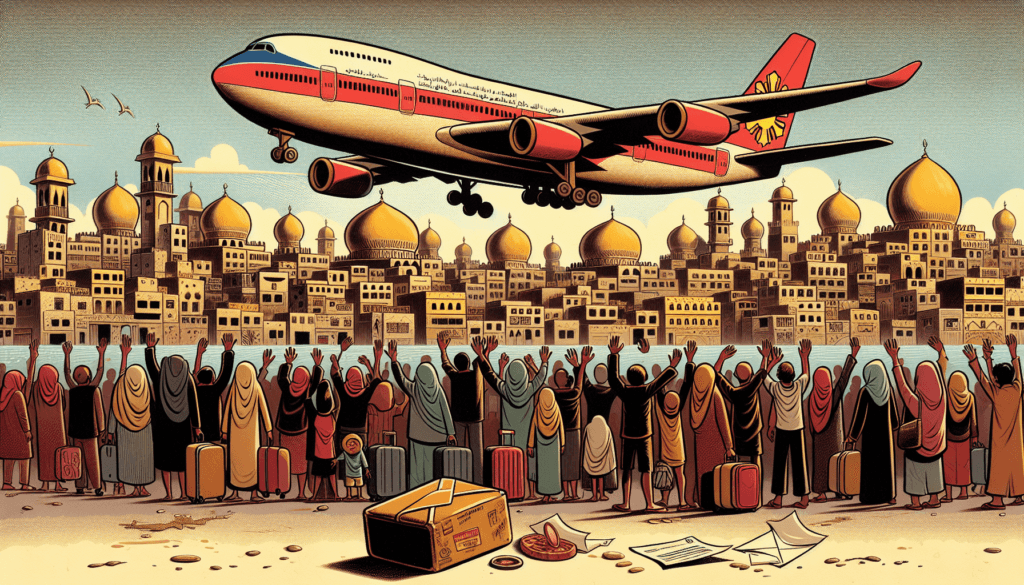
Quick Take
- The Philippine government is preparing contingency plans to evacuate thousands of OFWs from the Middle East as tensions between the US-Israel alliance and Iran escalate into potential open conflict.
- The DMW and DFA are activating protocols for over 2.3 million Filipinos across the Middle East. While only a few hundred are in Iran itself, the sheer scale of the population in the ‘impact zone’ makes this a logistical nightmare of unprecedented proportions.
- Watch whether Saudi Arabia and the UAE, home to the largest Filipino populations, stay neutral or get pulled in — that determines whether this is a managed repatriation or a crisis.
The Department of Foreign Affairs has dusted off its contingency plans — again.
The last time Manila seriously planned a mass evacuation from the Middle East was 2020, when the US killed Iranian General Qasem Soleimani and the region held its breath for a week. Nothing came of it then.
This time feels different.
The trigger this time around
The Philippine government convened emergency meetings across multiple agencies last week as the United States and Israel signaled coordinated military responses to Iranian positions. The Department of Energy held crisis talks on potential oil supply disruptions. The Department of Foreign Affairs activated its alert protocols for the 1.2 million Filipinos working across the Gulf states — from Dubai construction sites to Riyadh hospitals to Doha households.
Rappler reported initial assessments of how a US-Israel war with Iran would hit Filipinos in the UAE specifically, the second-largest destination for OFWs after Saudi Arabia. The scenarios range from temporary flight disruptions to full airspace closures, from panic buying at grocery stores to actual danger.
The Philippine Star confirmed that contingency planning is no longer theoretical. It’s active.
Why this keeps happening — and why it keeps getting worse
Filipinos have been the Middle East’s invisible workforce for nearly fifty years. We built the cities, staff the hospitals, clean the homes, wire the money back. The model worked because the Gulf stayed stable enough — coups elsewhere, wars elsewhere, but the oil flowed and the contracts renewed.
But that stability was always fragile, and it’s been cracking for a decade. The 2011 Libyan evacuation pulled out 26,000 Filipinos. The 2016 Saudi execution crisis strained diplomatic ties. The Yemen war put thousands of OFWs in Jeddah within missile range. Each time, the government scrambled, chartered planes, negotiated with host countries, brought people home.
And each time, after the crisis passed, they went back. Because there was no alternative.
The remittances from the Middle East alone totaled $5.8 billion in 2023. That’s not just numbers — that’s tuition, hospital bills, house construction, rice on the table in towns where local wages haven’t moved in twenty years. Kung tutuusin, it’s the economic policy we won’t admit we have: export people, import dollars, repeat.
So when the State Department starts using words like “imminent threat” and oil futures spike, the Philippine government doesn’t just worry about geopolitics. It worries about logistics — how many planes, which airports, how to pay for it, where people go when they land in Manila with no jobs waiting.
What this means for your family’s monthly padala
If you’re receiving remittances from the Gulf, here’s what changes fast.
First, the money slows or stops. Banks freeze transfers during conflicts. Even if your family member is safe and still working, getting cash out becomes difficult. During the 2020 Soleimani crisis, some OFWs reported week-long delays in remittance processing.
Second, oil prices climb — and oil prices in the Philippines mean everything gets more expensive. The Department of Energy didn’t call an emergency meeting for fun. A prolonged conflict that disrupts Gulf production would send pump prices past ₱70 per liter within weeks. Jeepney fares rise. Vegetables from Benguet cost more to truck down. Your household budget tightens from both ends: less coming in, more going out.
Third, if evacuations happen, they’re expensive for everyone. The government covers repatriation flights, but OFWs come home to no income and no immediate job prospects. Families that budgeted around $400 a month suddenly have an extra mouth to feed and no dollars coming in. Savings evaporate.
And if you’re an OFW reading this from Dubai or Riyadh: your embassy knows where you are only if you registered. If you didn’t, do it now. The DFA can’t help people it doesn’t know exist.
Editor’s Take
We’ve built an economy that requires a million Filipinos to live within blast radius of other people’s wars. Every few years, we rehearse the evacuation, update the spreadsheets, pray it doesn’t happen — and then send them back when it’s over. The government isn’t wrong to prepare; it would be criminal not to. But preparation isn’t policy. We’ve spent fifty years perfecting the logistics of extraction and almost no time building the kind of economy that wouldn’t require it. One day, we won’t get everyone out in time. The only question is whether that’s the day we finally admit the model was broken from the start.
Sources
Government prepares for mass OFW evacuation in Middle East — Philippine Star
US-Israel vs Iran war: The initial impact on Filipinos in UAE — Rappler
DOE holds emergency meeting on Iran crisis — Philippine Star