Eagles and Satellites: Two Ways to Guard What’s Ours
Quick Take
- Conservationists are urging Surigao communities to protect forest habitats critical to the survival of the Philippine eagle, while satellite internet technology is being pitched as a security solution for coastal towns near disputed waters.
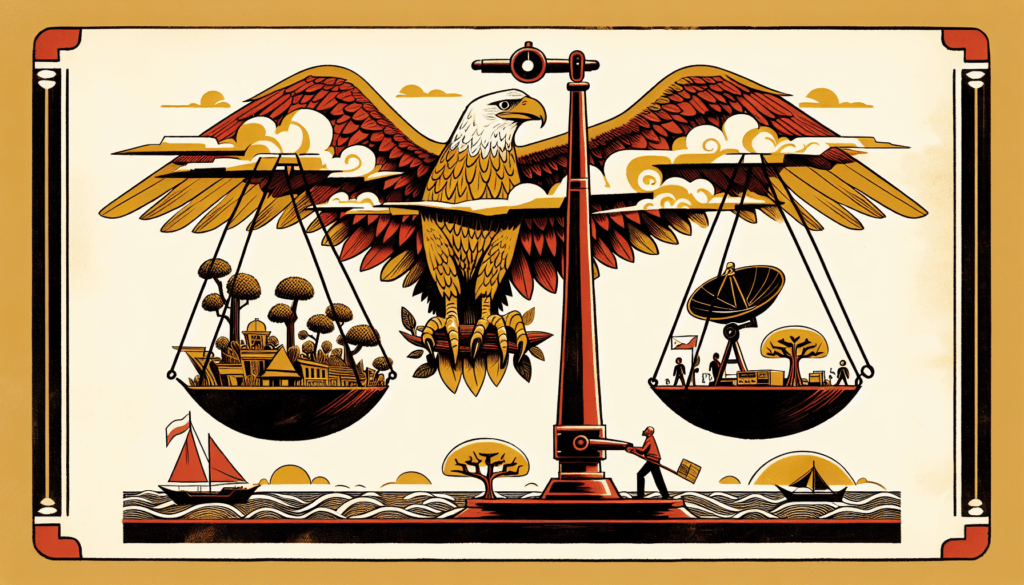
- One story asks Filipinos to guard what’s rare and ours; the other offers tech to watch what others claim is theirs — both about defending territory, one ecological, one geopolitical.
- Watch whether local communities get actual support for conservation work, and whether satellite deals come with transparency on costs and control.
Protecting forests in Surigao and monitoring seas in the West require different tools — but the same resolve.
The Philippine eagle needs about 13,000 hectares of old-growth forest to survive. Surigao’s remaining forests offer some of that. But the math gets harder every year.
What conservationists are asking for
Groups working to save the Philippine Eagle — the Haring Ibon, critically endangered and found nowhere else on earth — are calling on communities in Surigao to protect remaining forest cover. The eagle’s survival depends on large, undisturbed hunting grounds. Logging, land conversion, and human encroachment have already pushed the species to the edge. Fewer than 400 pairs are estimated to remain in the wild.
Surigao’s forests sit within the eagle’s known range. Conservationists say local cooperation is essential: no amount of captive breeding or policy work in Manila matters if the habitat continues to shrink. They’re asking residents to become stewards, not through top-down mandates, but through community-led forest management — the kind that works when people see the value in what they’re protecting, not just the cost.
It’s a familiar plea. And it’s one that often runs into an older, harder question: what do you tell a family that needs to eat?
What satellites are being sold for
Meanwhile, in towns hugging the coastline near the West Philippine Sea, a different kind of protection is being offered. Smart Communications and satellite providers are promoting internet connectivity via low-earth orbit satellites as a viable solution for remote coastal areas — places where terrestrial infrastructure is expensive or nonexistent.
The pitch is practical: better communication for fisherfolk, faster coordination during emergencies, and — though it’s spoken more quietly — improved monitoring capability in areas where Chinese vessels routinely intrude. Satellite internet doesn’t stop a militia boat, but it does mean a barangay captain can send a photo to authorities in real time.
The technology is real. The question is whether it will be accessible. Satellite internet costs more than fiber or cellular, and the towns that need it most are often the ones least able to pay for it. If the rollout depends on private contracts without subsidy or transparency, it risks becoming another tool only the well-connected can afford — literally.
Two fronts, same problem
Both stories are about sovereignty. One asks Filipinos to hold the line for a species that belongs only to us. The other offers a tool to watch over waters where we must constantly reassert control, at least in practice.
But sovereignty doesn’t enforce itself. Eagles need forests that aren’t cut. Coastal towns need internet they can actually afford and operate independently. Both require Filipinos to act as if what’s ours is worth defending — not someday, not when it’s convenient, but now, when it still exists.
The conservationists in Surigao aren’t asking for donations or awareness campaigns. They’re asking for land to stay forested. That’s harder. It means saying no to logging permits, to mining exploration, to the quick peso today in exchange for nothing tomorrow. It means communities have to see themselves as custodians of something larger than their own lifetimes.
The satellite advocates, for their part, need to answer a blunt question: who controls the network, and what happens when the subscription runs out?
Editor’s Take
Conservation and technology are usually framed as separate conversations. They are not. Both test whether we are willing to pay the real cost of keeping what makes this country ours. The eagle doesn’t care about budgets. The sea doesn’t wait. If we keep waiting for someone else to defend our forests and our waters, we will wake up one day and realize we have become tenants in our own land.
Sources
Save Surigao forests for eagles, conservationists ask locals — Inquirer
Smart satellites viable for towns close to West Philippine Sea — Philippine Star