Middle East War may Drag 8 Weeks as Fuel Fears Mount
Quick Take
- The Department of Foreign Affairs warns the Middle East conflict could stretch up to eight weeks, while President Trump signals intent to influence Iran’s next leader following the death of the Supreme Leader and lawmakers push for a national petrol reserve.
- Filipino households already facing ₱60-per-liter diesel and 2.44 million OFWs in the region now stare at a longer, costlier crisis with no clear exit.
- Watch fuel prices, repatriation timelines, and whether Congress moves the Strategic Petroleum Reserve Act from talk to tank.
The DFA’s timeline estimate arrives just as President Trump wades into succession politics and lawmakers scramble for energy buffers.
The Department of Foreign Affairs put a number on what many Filipinos have been dreading: up to four to eight weeks. That’s how long the current Middle East conflict could last, according to official projections. Not days. Not a quick flare-up that fizzles by next week. Two months.
What Lit the Fuse This Time
The immediate trigger was the massive escalation on March 1, but tensions have simmered for years. This round escalated faster than any in recent memory. Following the killing of Ayatollah Ali Khamenei, U.S. President Donald Trump publicly declared he wants a say in who leads Iran next, asserting American influence over the succession. Meanwhile, in Manila, Senate President Tito Sotto filed Senate Bill 1934: a national petrol reserve to cushion the Philippines against exactly this kind of shock.
The DFA’s eight-week estimate isn’t pulled from thin air. It factors in diplomatic back-channels, military assessments, and the grim arithmetic of how long conflicts like these typically burn before exhaustion or negotiation sets in. Still, eight weeks is a forecast, not a promise. Wars have a way of ignoring calendars.
Why This One Won’t Quit Easily
History suggests Middle East conflicts don’t resolve quickly when major powers start picking sides. The 1990 Gulf War lasted six weeks of air strikes and four days of ground combat—but the buildup took months, and sanctions stretched for years. The 2006 Lebanon conflict ran 34 days. The 2003 Iraq invasion’s “major combat operations” lasted three weeks; the aftermath, over a decade.
This time, President Trump’s insistence on choosing Khamenei’s successor adds a layer of unpredictability. As the sitting U.S. President, his statements dictate current global policy. This means Iran’s next moves will account for a White House that is actively involved in regime transition. That’s the kind of calculation that extends conflicts, not shortens them.
And yet, the real accelerant here isn’t ideology—it’s oil. The Strait of Hormuz, through which a fifth of the world’s petroleum passes, sits right in the middle of this. Any disruption there doesn’t just rattle markets; it rewrites household budgets from Quezon City to Zamboanga.
What Eight Weeks Means for Your Jeepney, Your Remittance, Your Grocery Run
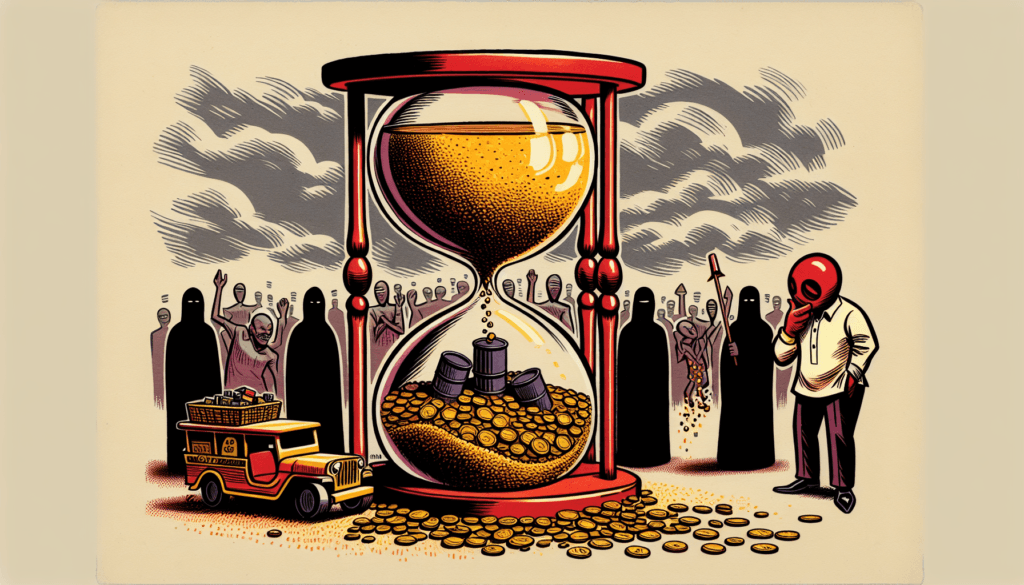
Let’s make this concrete. Diesel in Metro Manila already hovers around ₱56 to ₱60 per liter. However, with the conflict dragging, industry experts predict a “big-time” hike of up to ₱15 per liter as early as next week. For a jeepney driver burning 30 liters a day, that’s an extra ₱450 in daily expenses—money that either comes out of their pocket or gets passed to passengers through fare hikes that require government approval, which takes time.
For the 2.44 million OFWs in the Middle East, eight weeks means two things: uncertainty about whether to stay or leave, and rising costs if they choose to come home. Repatriation protocols are already active, with the government prioritizing those in high-risk zones like Iran and Iraq (Alert Level 4). Plane tickets spike during crises. And once back, there’s no guarantee of immediate work.
Then there’s the grocery bill. The Philippines imports heavily—rice, wheat, cooking oil. All of it moves on ships burning fuel. When fuel costs jump, so does everything else, usually with a two-week lag. The ₱200 you spent on a kilo of chicken last month might be ₱230 by the time this conflict hits its midpoint.
Congress knows this, which is why the Philippine Strategic Petroleum Reserve Act resurfaced. The idea: a state-managed stockpile to last at least 90 days. While President Marcos Jr. recently assured the nation that commercial stocks are currently stable for 50 to 60 days, the bill seeks a permanent government-owned buffer. It’s smart in theory. In practice, it requires billions in upfront investment, storage infrastructure, and the political will to spend on something that only pays off during a crisis.
Editor’s Take
Eight weeks is long enough for a war to become routine, for headlines to fade, for people to stop checking the news every morning. That’s the danger. This isn’t a spectacle Filipinos can afford to tune out. Every week the conflict drags, fuel gets pricier, remittances get shakier, and the cost of waiting for government action compounds. The DFA gave us a timeline; Congress floated a solution. The question isn’t whether we can afford a national petrol reserve. It’s whether we can afford not to have one the next time this happens—because, talagang there will be a next time. The only thing more expensive than preparing for a crisis is pretending it won’t come.
Sources
Middle East war could last up to 8 weeks – DFA — Philippine Star
Trump wants say on Iran’s next leader as war intensifies — Rappler
National petrol reserve pushed amid Middle East crisis — Philippine Star
Marcos: PH fuel supply stable for 60 days – Philippine Information Agency