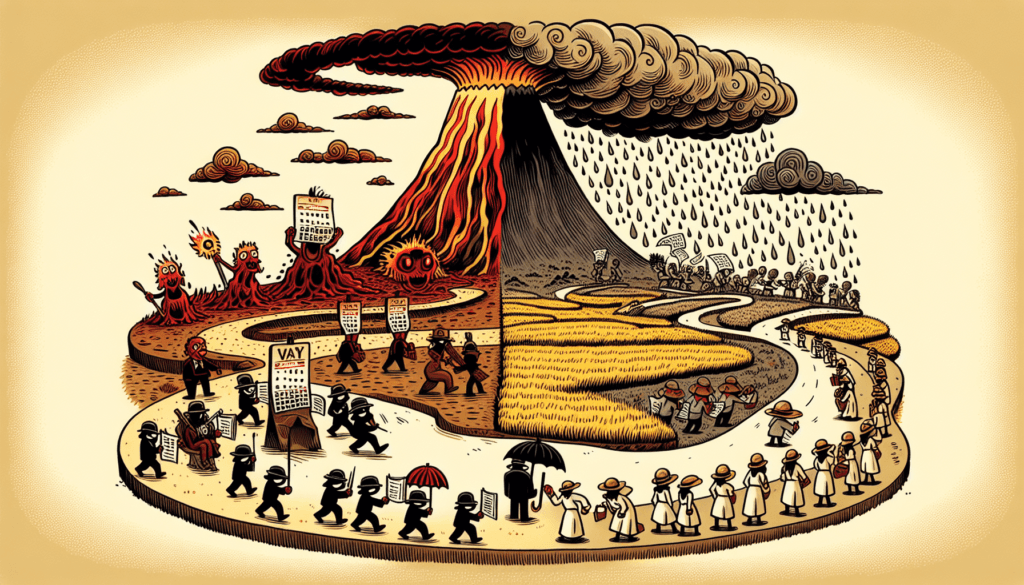
Kanlaon erupts as amihan weakens across Luzon
Quick Take
- Mount Kanlaon erupted, sparking fires and blanketing Negros villages in ashfall, while the weakening amihan brings cloudy skies and light rains across Luzon.
- Farmers, fisherfolk, and families near the volcano face immediate health risks and livelihood losses, even as cooler weather elsewhere offers brief relief from the heat.
- Watch for PHIVOLCS updates on Kanlaon’s activity level and whether ashfall will spread beyond Negros as weather patterns shift.
Two weather stories, one country — and only one of them comes with ash.
The sky over Negros turned gray Tuesday as Mount Kanlaon reportedly erupted, sending ashfall across villages and igniting fires near the crater. Meanwhile, hundreds of kilometers north, Luzon woke to cloudy skies and light rains as the northeast monsoon—the amihan—continues to weaken ahead of the dry season’s full arrival.
When a volcano wakes up during weather season
Kanlaon’s eruption wasn’t entirely unexpected. PHIVOLCS had been monitoring increased unrest for weeks. Still, the timing adds a layer of complication: ashfall doesn’t care about monsoon patterns, but the weakening amihan does affect how far and fast that ash will drift.
Ash from the eruption blanketed barangays on Kanlaon’s slopes, coating roofs, crops, and water sources. According to local disaster officials, fires broke out near the crater—likely ignited by pyroclastic material meeting dry vegetation. For communities that depend on sugarcane and vegetable farming, the ashfall means immediate losses. In Western Visayas, Negros Occidental produces the overwhelming majority of Western Visayas sugarcane, according to the Philippine Statistics Authority. Even a thin layer of ash can damage seedlings and contaminate irrigation systems. Anything thicker turns fields into gray wastelands that take weeks to rehabilitate.
And yet, up in Luzon, the weather feels almost gentle. The amihan, which brought cooler mornings and occasional drizzle since November, is losing its grip. That means warmer days ahead, but for now, the cloud cover and light rains offer a brief reprieve before the summer heat arrives in earnest.
What ashfall does to your lungs and your livelihood
If you live within 10 kilometers of Kanlaon, the math is simple: stay indoors, keep windows shut, and if you must go out, wear an N95 mask—not a surgical one, which won’t filter fine ash particles. Volcanic ash isn’t like dust. It’s made of tiny glass shards and rock fragments that can scratch your corneas and scar your lungs with repeated exposure.
For farmers, the damage is both immediate and delayed. Ashfall blocks sunlight, which stunts photosynthesis. It contaminates irrigation water, making it too abrasive for pumps and too alkaline for some crops. Livestock that graze on ash-covered grass can develop digestive problems. The economic hit can stretch for months, even after the ash is cleared.
In Luzon, the weakening amihan brings its own set of trade-offs. Cooler weather means lower electricity bills—less need for electric fans—but it also signals the approaching dry season. PAGASA’s January-June 2026 seasonal outlook says the termination of amihan is expected in March. Farmers there are watching water levels in irrigation systems, knowing that once the rains stop completely, they’ll be rationing until June.
What the skies are telling us
Kanlaon sits in the Pacific Ring of Fire, the same tectonic neighborhood that gave us Pinatubo, Mayon, and Taal. Eruptions here aren’t anomalies—they’re reminders. The Philippines has 24 active volcanoes, and at any given time, at least a handful are showing signs of unrest. We live on restless ground.
The amihan, meanwhile, follows a pattern Filipinos have known for generations. It arrives around November, peaks in January, and fades by March. This year’s weakening is right on schedule. But climate patterns are shifting globally, and what used to be predictable—monsoon strength, dry season length—feels less certain now.
What’s striking is how these two systems—geological and meteorological—operate on entirely different timescales, yet intersect in the lives of ordinary Filipinos. A volcano erupts over minutes. A monsoon weakens over weeks. Both reshape the daily decisions of millions.
Editor’s Take
We treat weather and disasters as separate beats, but for the families living under Kanlaon’s shadow, they’re the same story: the sky, and what it decides to send down. The amihan’s retreat up north means summer is coming, which means water rationing, higher electric bills, and the annual debate over whether this will be the year we finally fix our irrigation systems. Down south, ashfall means masks, ruined crops, and the quiet arithmetic of whether to stay or evacuate. Kung tutuusin, both are about waiting—for rain, for quiet, for the ground and sky to give us a break. The Philippines doesn’t get to choose its geography, but we do get to choose how seriously we prepare for it.
Sources
Kanlaon eruption sparks fires; ashfall hits Negros villages — Inquirer
Cloudy skies, light rains to prevail in Luzon as amihan weakens — Inquirer
Major/Priority Crops Production in Western Visayas Fourth Quarter of 2024 — Philippine Statistics Authority
Seasonal Outlook, January-June 2026 — PAGASA
Volcanoes of the Philippines — PHIVOLCS